
HP-J7
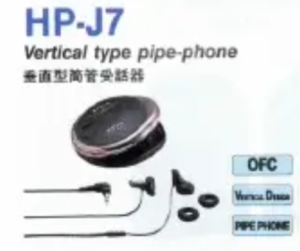
Variants: HP-J8 (added volume control)
Year: 1990
Frequency Response (Hz): 8-25,000
Sensitivity (dB/mW): 105
Impedance (Ohms): 16
Review / Info: (7/10) The Aiwa HP-J series is unique for having a vertical position of the drivers, as seen in the Sony MDR-A/W series, except without the use of a headband. Upon use, I was very impressed with just how small these earphones are and how light they are once they sit in your ear. On the other hand, you do have to play a little more to make sure they are sitting correctly. I can agree with the common consensus that these earphones do have a warmer and bass-heavy presentation. Lots of great sub-like bass (as much as an earphone can) with impactful drive, though not as punchy as the MDR-W501. Nonetheless, a very fun and colorful listen. In contrast, the mids and highs do seem to be somewhat lacking and are overpowered by this earphone’s bass, becoming at times muddy. In addition, separation and “openness” feel lukewarm compared to even the MDR-A20 despite also being in a vertical style. With that said, some textures and details feel absent but would be about on par with the MDR-A20; besides, again, the less separation as noted. Overall, a more colorful and comfy set of earphones that are great for bassheads but probably wouldn’t be as satisfying for intent and detail-oriented listening.
A Historical Review: “A second pair of in- ear phones from Aiwa, also utilising the ‘ pipe’ idea. This time though, the tubing is hidden in a horizontal projection from the earpiece instead of a vertical one. Whether it was this, or that these phones had a thin rubber- like ring round them instead of the thin foam of the HPD9s, I don’t know, but these felt a good deal more secure in my ears. Claimed frequency response is a less exaggerated 8Hz-25kHz, impedance I 6ohms, sensitivity I 05dB/mW and power 10-40mV. The fashion instinct has been diverted in these from colouring a pair of tiny organ- pipes gold into the ‘fashion’ case, which has a garish gold edge to it, and is, heaven help us, shaped like an ear. Presumably this is so we won’t mistake it for a cigarette case or powder compact when fishing in our pockets or bags. Again, if any signals were coming through at 8Hz, my own grey cells remained intact, with no fewer dying off than is to be expected at my age anyway. Treble, while not as fierce and sharp as the HP-D9s, was didtinctly over- bright, though the mid-range displayed commendable detail and imaging precision. Lower mid was not as tonally accurate or as pleasant as the Sonys and sounded slightly bitter. Instruments were less easy to follow, and the soundstage developed a wider spread to left and right Rory Block’s voice whined rather, and the blues harp showed transitions from middle range to upper notes with a small hiccup followed Dy a fairly fierce zing. Large-scale orchestral works simply lacked weight and presence; string tone was sour, while rapid successions of notes on piano became a muddled and rather tinny. Curiously, these were the only headphones which didn’t clearly mark which was Left and which was Right.
Summary: Two of the sets came with a screw- on 1/4 in jackplug adaptor, the Sony MDR-W501Ls and Aiwa HPD-9s, though I would only recommend the former for use at home. Regardless of the merits ( imaginary or otherwise, as far as frequencies like 3Hz go) the ‘ organ- pipe’ Aiwa HP-D9s were the better of the two pairs from this company, and while more detailed than the in- ear (and pipeless) ones supplied with the Technics player, I preferred the latter’s smoother overall balance, mid- range muddle notwithstanding. The Aiwa HP-J7s, while less fierce, were also thinner and muddled. Of the two Sonys, the Sports model showed the limitations of size, with a slight but noticeable increase of sizzle in the treble. It really was only the larger MDR-W50 I Ls that stood up for the quality the Technics portable could offer and packed it into the earlobes relatively uncoloured. They might not be the most convenient to carry, and they look unmistakeably like headphones, but they were the only ones which could also satisfactorily be used for late- night listening at home while the neighbours are asleep. In the end, size – at least of the diaphragm in the earpiece – count.”
Braithwaite, Eric. “Canned Sound: Four pairs of headphones suitable for personals”. Hi-Fi World, Nov 1991, pp. 104-105