
MDR-E472
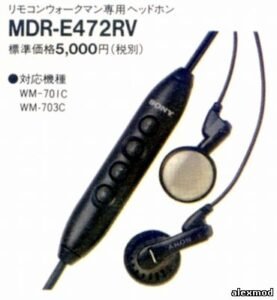
Variants: MDR-E472RVF, others in different striping
Year: 1988
Frequency Response (Hz): 10-23000
Sensitivity (dB/mW) : 108 dB/mW
Impedance (Ohms):18
Review / Info: (6/10)
The MDR-E472 was a remote-built-in earphone typically bundled with Sony’s flagship Walkmans of the late 1980s and early 1990s. Rather than using a standard 3.5 mm headphone plug, it featured one of Sony’s proprietary connectors designed to interface directly with compatible Walkmans. Because of this, a common modification is converting the proprietary connector to a standard headphone jack. I also modified the pair I had in this way, with both the original connector and remote section removed. One of the most persistent myths surrounding the MDR-E472 is that it uses the same driver as the MDR-E484 just housed in a less expensive, non-ceramic shell. Numerous driver teardowns have disproven this claim, revealing clear physical differences between the two drivers that are also reflected in their distinct sound signatures. Sonically, the MDR-E472 departs from the warm, bass-heavy tuning that characterized many Sony earphones of the 1980s. Instead, it presents a noticeably flatter, more technical, and somewhat colder sound. Compared to the MDR-A20, the mids are brought further forward while the bass takes a clear step back. Even with bass EQ applied, the low end never achieves the punch or physical impact of the MDR-A20 or many of its contemporaries. On the other hand, these earphones are very clear and precise, catchning more detail and subtlety than the MDR-A20. Despite its leaner presentation, the MDR-E472 remains surprisingly smooth and avoids becoming overly harsh or fatiguing. Where it truly excels is again in its technical performance. Detail retrieval, clarity, and dynamic contrast are all impressive, reaching a level comparable to the MDR-A50LV or better. While I personally prefer a fuller, more impactful low end, I can easily understand why these earphones have earned such a strong reputation among enthusiasts. Their midrange-focused presentation and excellent technical ability make them particularly well-suited for vocal-centric music and listeners who prioritize clarity over bass quantity.